EPIGENETIC ANALYSIS

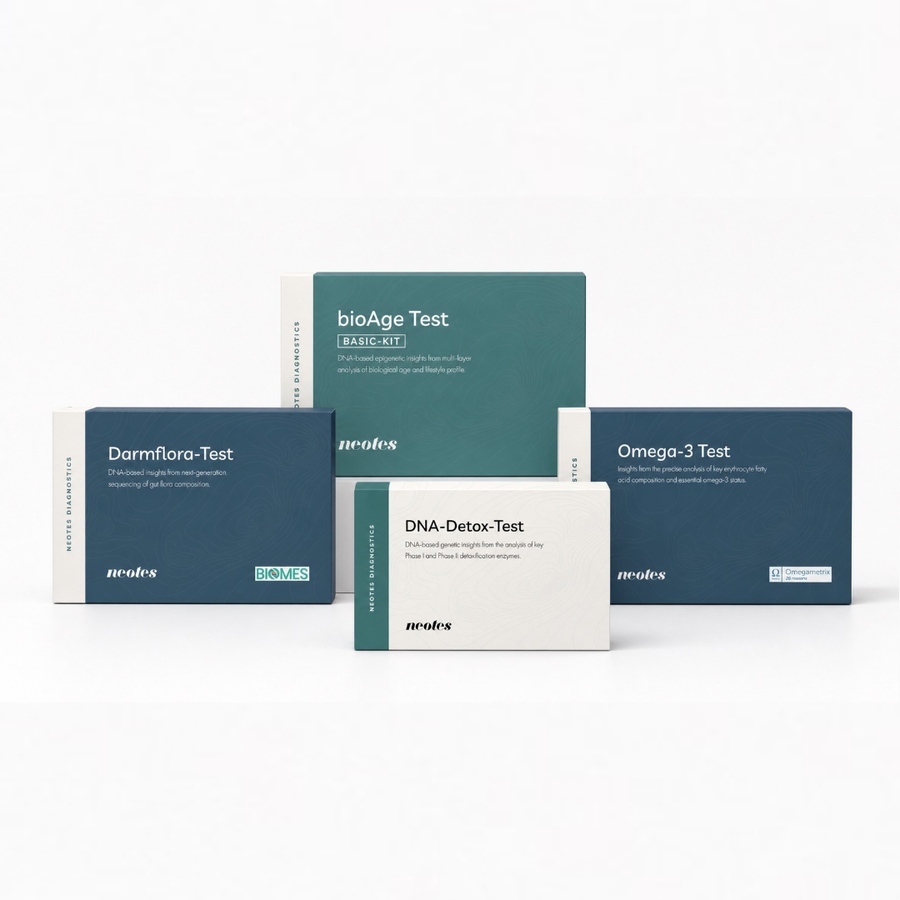
    bioAge Test

    ★★★★★
    ★★★★★
    4,81 / 5 · 126 reviews

    How does your lifestyle influence your biological age?
    The bioAge Test uses the GrimAge method by Prof. Dr. Steve Horvath, one of the world’s most established epigenetic age clocks.

    • Epigenetic self-test with dried blood for at home

    • Determination of biological age according to the Horvath Clock

    • Analysis of approx. 935,000 epigenetic DNA sites

    • Ideal for optimizing your personal longevity routine

    • Detailed report with comparison to your age

    • Biological age precisely measured through 935,000 DNA methylation patterns
    • Fitness and nutrition profile shows how your lifestyle influences key longevity factors
    • Science-based lifestyle recommendations, based on your personal result, for a balanced biological age over the long term
    Sale price CHF 285.00Regular price
    Regular price CHF 285.00
    Tax included. Shipping calculated at checkout.
    bioAge Test
    Sale price CHF 285.00Regular price
    Regular price CHF 285.00
    VAT included
    Delivered within 1–3 business days Free shipping

    The upgrade for your longevity routine

    • Epigenetic at-home test using dried blood

      The neotes bioAge test kit is designed for straightforward sample collection at home. To perform the test, a few drops of capillary blood are placed on a dried-blood card, which is then sent to a specialised German laboratory for analysis.
    • Determination of biological age and additional epigenetic parameters

      According to leading anti-ageing physicians, the Horvath Clock is considered the gold standard for measuring biological age. Depending on the test version, additional epigenetic parameters are evaluated that may provide information about functional areas relevant to longevity. Practical measures can also be discussed during a medical longevity consultation.
    • Analysis of more than 900,000 epigenetic sites

      For the measurement, we use the Illumina EPIC 2 microarray, currently the most comprehensive chip of its kind. It analyses approximately 935,000 sites across the DNA and captures a highly detailed methylation profile. The data are evaluated using a computational approach that significantly improves on the accuracy of previous biological clocks.
    • Measurement for your personal longevity routine

      Epigenetic markers are dynamic: they respond to factors such as diet, exercise, sleep, stress and environmental exposures and can change over time. This is precisely where their potential lies. The test result can show how the effects of targeted lifestyle changes or medical measures are reflected in biological age and other epigenetic markers over the medium to long term. This provides a new perspective on the interaction between lifestyle, environment and the individual ageing process and may encourage you to adjust or maintain specific routines in order to minimise the negative effects of ageing.
    • Detailed report comparing biological and chronological age

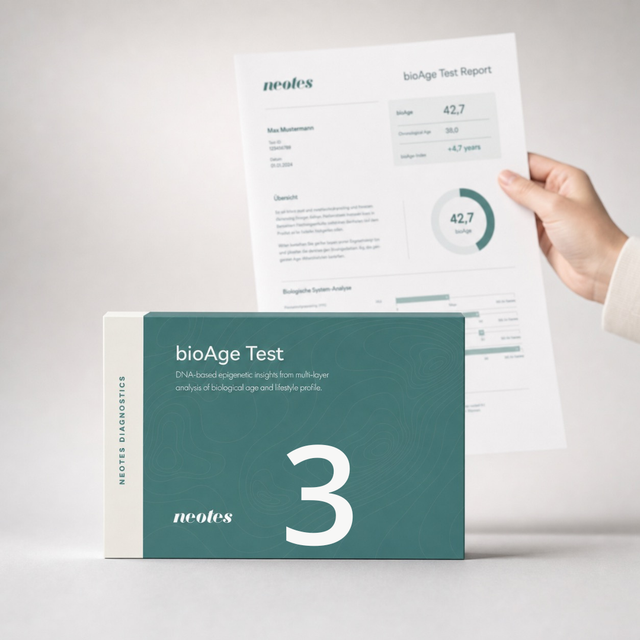
      Once the sample has been received and analysed by the laboratory, the bioAge Report is available after approximately four weeks. The report presents the results in a structured format and compares the determined biological age with your chronological age, showing whether your epigenetic profile is currently ageing more slowly, at a corresponding rate or more quickly. Depending on the package selected, you will also receive insights into epigenetic fitness and nutrition profiles as well as selected risk and performance markers.
    The upgrade for your longevity routine

    The bioAge Test is different

    neotes bioAge Test
    Empfohlen
    Simplified lab tests
    Questionnaires & fitness checks

    DNA methylation, epigenetic markers: biological age, fitness and nutrition profile, smoking profile, risk factors, telomere length, VO2max, fitness age, grip strength

    Reduced epigenetic markers, usually only biological age or selected proteins in saliva

    Self-perception/lifestyle or body data in the gym, with little or no prospective validation as a biomarker of biological age

    Dried blood

    Saliva

    No sample

    Use of established epigenetic clocks (GrimAge clock, Horvath clock), which are currently the best scientifically validated and are often described in reviews as the "gold standard" for biological age; analysis of approximately 935,000 CpG sites, use in research and additional markers, a clear methodology with high precision and a large comparison database

    Calculation on a smaller data basis, a limited number of CpG sites, sometimes less studied models, and the epigenetic clock is often unknown

    Simple scores or standard fitness values

    Epigenetic clocks with a direct link to ageing processes; they map systemic ageing

    Low to moderate, depending on the test; indications of ageing processes, but less thoroughly studied epigenetic clocks

    Low to indirect; mainly reflects your current fitness and lifestyle profile

    Specific, science-based lifestyle tips; medical longevity consultation available

    General lifestyle advice, with little to no medical interpretation

    Generic tips / training recommendations

    A realistically stated interval for re-measurement, every 6–12 months; Longevity Club for long-term support

    Progress measurements possible, often without a long-term concept

    Motivational check, with a focus more on training progress supported by a fitness coach

    Hinweis: Ein biologischer Alterstest ist nicht gleich biologischer Alterstest. Wissenschaftlich betrachtet beruhen die dargestellten Verfahren auf grundlegend unterschiedlichen Messprinzipien (Selbstauskunft, funktionelle Tests, Proteomik‑/Speicheltests vs. DNA‑Methylierung im Blut). Epigenetische Bluttests gelten derzeit als eine der am besten untersuchten Methoden zur Abschätzung des biologischen Alters.

    What’s included in the report?

    Understanding the bioAge test

    Your ID says 45. Your body says 40 – or 52.

    Biological age measures how fit and healthy your body actually is at the cellular level – regardless of what your passport says. It is based on epigenetic markers in your DNA and is one of the most meaningful predictors of life expectancy and health risks.

    The key point: your biological age can be changed. Diet, exercise, sleep and stress management directly influence how quickly – or slowly – your cells age.

    How does the neotes bioAge test work?

    1. Schritt

    Order your neotes bioAge test and receive your test kit at home within 1–3 working days. Then activate your individual kit ID.

    2. Schritt

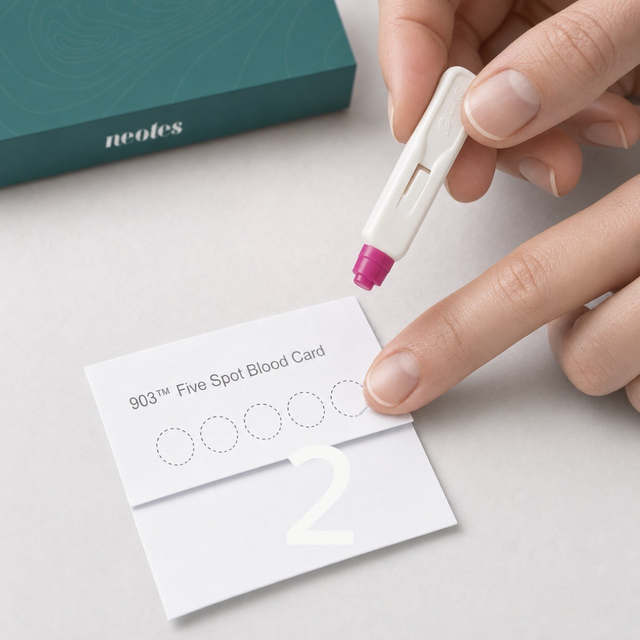
    Using the lancet, take a few drops of capillary blood from your fingertip and apply them to the test card. Allow the card to dry and place it in the prepared return envelope.

    3. Schritt

    In a certified German laboratory, your DNA is analysed and your biological age as well as further relevant markers are determined. After about four weeks you will receive your report – with the Premium package including a longevity medical consultation.

    Scientific expertise
    “The bioAge Test is establishing itself as the gold standard among epigenetic age tests by providing precise insights into biological age and thus representing an objectively measurable parameter for longevity medicine.”Prof. Dr. med. Dietrich Baumgart Metamedicum Düsseldorf Private Specialist Medical Centre


    FAQ

    We have the answers

    Yes, the neotes bioAge test is an epigenetic self-test that you can conveniently carry out at home. You receive a test kit with detailed instructions and take a few drops of blood from your fingertip yourself, which are applied to the test card and then sent to the laboratory.​

    The Longevity Gene Test analyzes genetic variants—comparatively stable characteristics of your DNA that generally do not change over the course of your life. The bioAge Test, by contrast, measures epigenetic patterns and additional blood markers that are strongly influenced by your current lifestyle and may change over time in response to nutrition, exercise, sleep and stress management.

    Yes. Like established epigenetic age clocks, the neotes bioAge Test is based on the analysis of characteristic DNA methylation patterns, as first described by Steve Horvath for estimating age.

    The test is aimed at adults of legal age (18 and over) who want to optimise their biological age and lifestyle in a targeted way. As a rule, the test is useful from around the age of 30, especially if you are engaging with prevention, performance or longevity.

    The test kits are usually good for several months; the exact best-before date can be found on the packaging. It is important to store the kit in a dry place at room temperature and to use it by this date at the latest, so that sample quality is ensured.​

    The test kit is activated via a code on the neotes platform before sample collection.

    Yes. An upgrade is possible as long as the test kit is still in its original condition and has not yet been registered. Please contact customer service before collecting your sample so that we can update the order and explain the next steps.

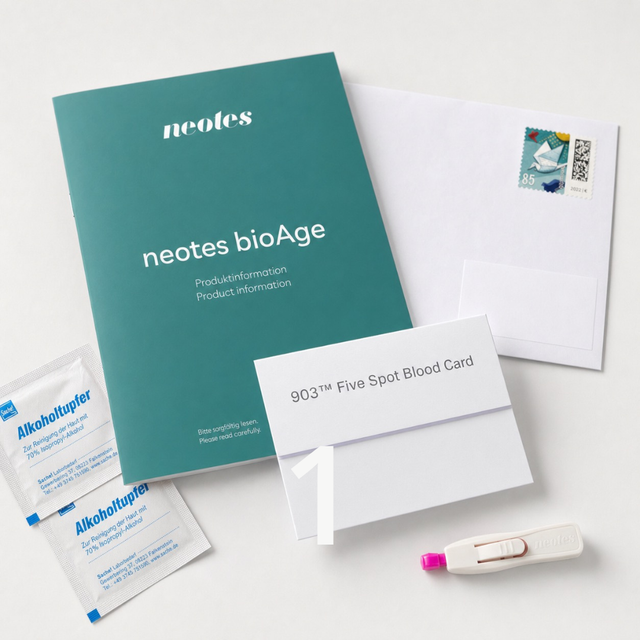
    In the test kit you will find everything you need for sample collection: a blood-collection lancet, a dried-blood card, a disinfectant wipe, a plaster, an illustrated step-by-step guide and return packaging for shipment to the laboratory.

    You can easily give the bioAge test as a gift, for example via our digital Longevity Card as a gift voucher. The recipient can use it to select and order the bioAge test themselves and follow the entire process independently. Click here to access the Longevity Card as a gift voucher.

    The Longevity Club generally offers a discounted price and additional services such as regular follow-up tests, exclusive content and personal guidance when interpreting your results. This makes the test part of a structured longevity strategy.

    First you activate your test kit online, then you use the lancet to take a few drops of capillary blood from your fingertip and apply them to the marked fields on the dried-blood card. You then let the card dry completely, pack it in the protective sleeve provided and, ideally on the day you carry out the test, send it to the laboratory using the enclosed return envelope.

    It is important to warm the fingertip thoroughly, for example with warm water, and allow the sample to drip directly onto the test card without touching the filter area.

    If you were acutely ill or had a fever in the days or weeks before collection, are pregnant or breastfeeding, or experience significant menstrual-cycle fluctuations, you should, where possible, wait until your health is stable and you are at a regular point in your cycle, as severe inflammation or exceptional hormonal circumstances can temporarily affect biological markers.

    Ideally, send your sample on the day it is collected or on the next business day so that transport and storage times remain as short as possible. When this is not possible, the fully dried blood collection card can be stored for several days in a dry, dark place at room temperature before shipping. Nevertheless, try to send it within a few days of collection.

    After collection, let the blood card dry completely and then store it in a dry, dark place at room temperature. Send the sample off as soon as possible, ideally within a few days, so that its quality is maintained.

    You can generally collect the sample at any time of day. However, the ideal time is when you are following your normal daily routine, rather than immediately after intense physical exertion, heavy alcohol consumption or during an acute illness.

    In principle, you can carry out the test even while taking medication. Some medications can influence epigenetic patterns and therefore the calculated biological age; if you are unsure, it is advisable to consult your doctor and to document your medication accordingly when interpreting the results.

    As a rule, you do not need to stop taking supplements before the test because the test is intended to reflect your lifestyle and its epigenetic effects. However, when you have only recently started new supplements or are planning a therapy and want to document a genuine baseline value, it may be useful to test before starting or after a sufficiently long and stable period.

    The return address is already pre-printed on the enclosed return envelope. You only need to pack the sample as described and send it via regular post; no further address details are needed.

    For returns from abroad, you should follow the enclosed shipping instructions and declare the test kit as a low-risk biological sample, as described in the instructions. You should allow for possible delays due to customs or longer transit times and send the sample as soon as possible after collection.

    Yes, you can carry out the sample collection together with your doctor if they would like to support you. However, the test itself remains a self-test with submission to the specialised laboratory.

    The results report shows your biological age compared with your chronological age, graphical overviews of the most important epigenetic parameters, as well as risk profiles and recommendation notes. At a glance you can see whether your biological age is accelerated or slowed and in which areas there is the greatest need for action.

    Click here to view an excerpt from a sample report.

    After your sample arrives at the laboratory, the analysis usually takes about 3–4 weeks. As soon as the report is complete, you will be notified by email and can access your results report.

    Your data is processed pseudonymously, which means the laboratory works with a sample code and not with your name. The digital results report is provided via a secure platform, and data processing takes place in accordance with the applicable data protection standards.​

    The test analyses the methylation patterns of your DNA at a large number of defined positions and supplements this data with further markers associated with ageing and health.

    A special algorithm compares your personal methylation profile with large reference cohorts of your age and sex and, from this, calculates your biological age and additional biomarkers.

    If you deliberately change your diet, exercise, sleep or other lifestyle factors, you can use repeat tests to check whether your biological age stabilises, slows down or even becomes younger over time. Your bioAge value and further parameters thus become objective feedback for your personal longevity programme.

    A single test is sufficient for a simple assessment of your current status. If you want to test specific interventions, control measurements are recommended roughly every 6–12 months, as epigenetic changes need time to be stably reflected in the profile. Shorter intervals usually provide only limited additional benefit.

    The neotes bioAge Test uses modern DNA methylation microarrays, such as the Illumina MethylationEPIC v2 array, to measure methylation at hundreds of thousands of defined CpG sites across the genome. These platforms are established in numerous scientific studies, show high reproducibility and are widely used in research on epigenetic clocks and aging biomarkers.

    The methylation values at a selection of particularly informative CpG sites are extracted from the array data and entered into a statistical algorithm trained on large reference cohorts of known chronological age. The calculation follows the principle of the Horvath clock and more advanced epigenetic age models.

    Epigenetic ageing tests are currently among the most precise methods for calculating biological age from blood samples. The underlying algorithms are based on large scientific data sets.

    If your biological age is clearly higher than your chronological age, this may indicate accelerated aging and a higher risk of age-associated conditions. It is then useful to work with qualified professionals on nutrition, exercise, sleep, stress management and other relevant factors while considering additional health data.

    The report and the consultation (Premium only) contain personalised recommendations on diet, exercise, recovery and other factors that influence your biological age. This way you receive not only figures, but also practical guidance on how to improve your longevity profile.

    The longevity consultation is included only in the Premium Test and is initially designed as a single session. If you would like longer-term support, you can book additional follow-up appointments with selected physicians.

    The longevity consultation is currently available in German. Additional languages may be offered in the future; please contact us if you have a specific language requirement.

    Yes, you can go through your report in detail with a doctor or a longevity expert. With the Premium package, this medical discussion of results is already included; with the Basic package, you can book a longevity consultation as an optional extra.

    You can book the longevity consultation after receiving your results. You will then receive a notification for appointment booking, through which you can conveniently choose a suitable time.

    Additional consultation packages can be booked if desired. During the consultation, your test results are placed in the context of your overall health and longevity profile, and practical nutrition and lifestyle strategies are developed with you.