Like most genes, the GUCY1A3 gene contains thousands of genetic variants (SNPs). However, the vast majority of these variants have no known functional effect on gene activity or on the protein produced from it. Research therefore focuses on variants that are biologically plausible (for example, located in regulatory gene regions), correlate significantly with a clinical trait in large population-based studies (for example, GWAS), and have been replicated, meaning confirmed again in independent studies.
The rs7692387 variant (G > A) meets precisely these criteria. It is located in the promoter region of the GUCY1A3 gene—the section that controls gene activity. Studies (Hall et al., European Heart Journal, 2019; Kessler et al., Cardiovascular Research, 2019) show that this variant may influence the expression of soluble guanylate cyclase and could thereby modulate the response to acetylsalicylic acid (ASA).
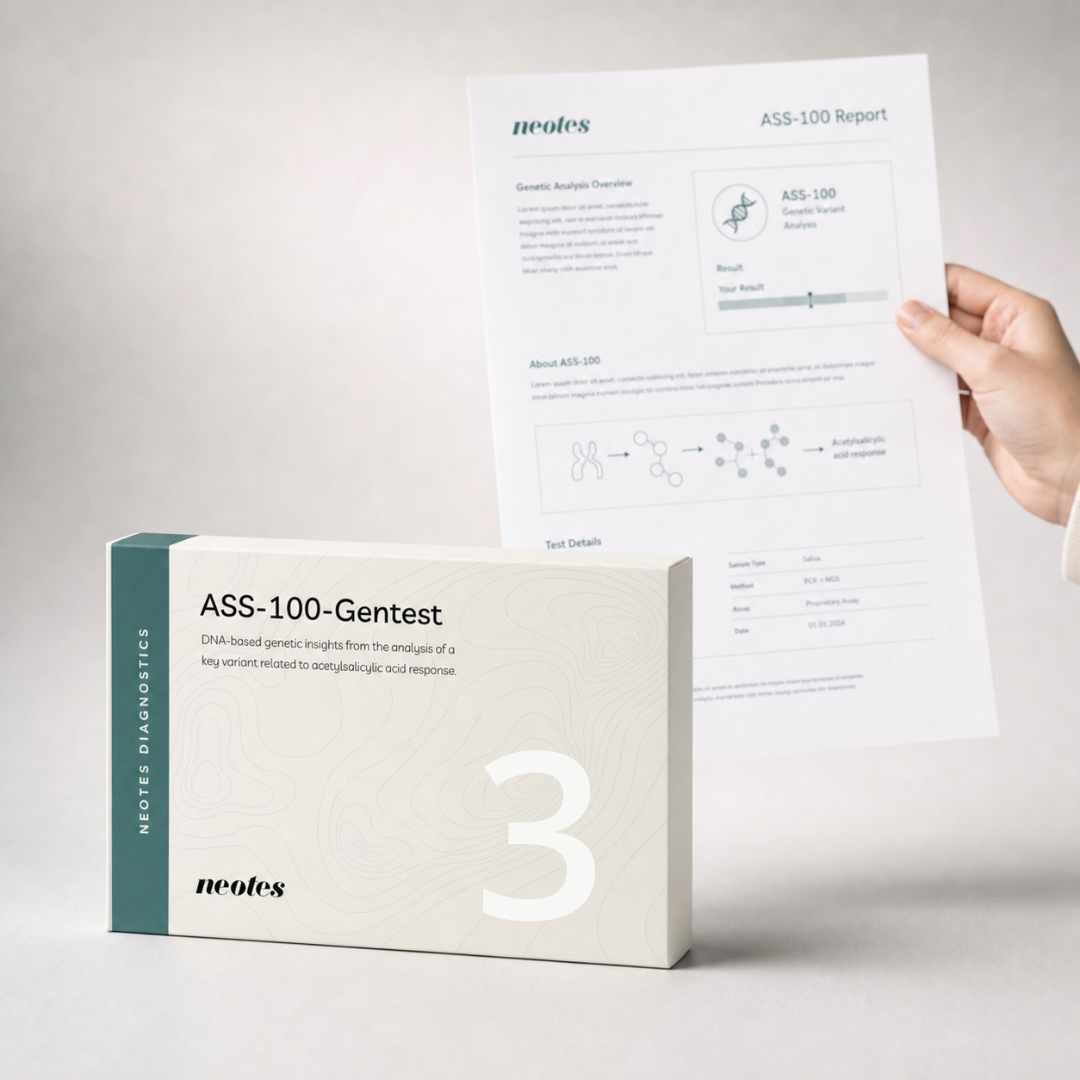
To date, rs7692387 is the only variant whose association with the effect of ASA has been demonstrated in a scientifically reproducible manner. The GUCY1A3 gene mutation, which may influence your response to acetylsalicylic acid (ASA) and your cardiovascular health, is therefore analyzed specifically.
Other SNPs in the GUCY1A3 gene or in neighboring genes (for example, GUCY1B3) have been described, but their influence on the effect of ASA has not yet been clearly demonstrated.
The GUCY1A3 gene encodes a subunit of soluble guanylate cyclase, an enzyme in the nitric oxide (NO) signaling pathway that is substantially involved in regulating vascular tone and platelet function—precisely the area in which ASA acts.
Studies show that this variation may influence the individual response to acetylsalicylic acid (ASA):
Kathryn T. Hall et al. (2019). Genetic variation at the coronary artery disease risk locus GUCY1A3 modifies cardiovascular disease prevention effects of aspirin. European Heart Journal, 40(41), 3385‑3392.
Thorsten Kessler et al. (2019). Association of the coronary artery disease risk gene GUCY1A3 with ischaemic events after coronary intervention. Cardiovascular Research, 115(10), 1512‑1518.